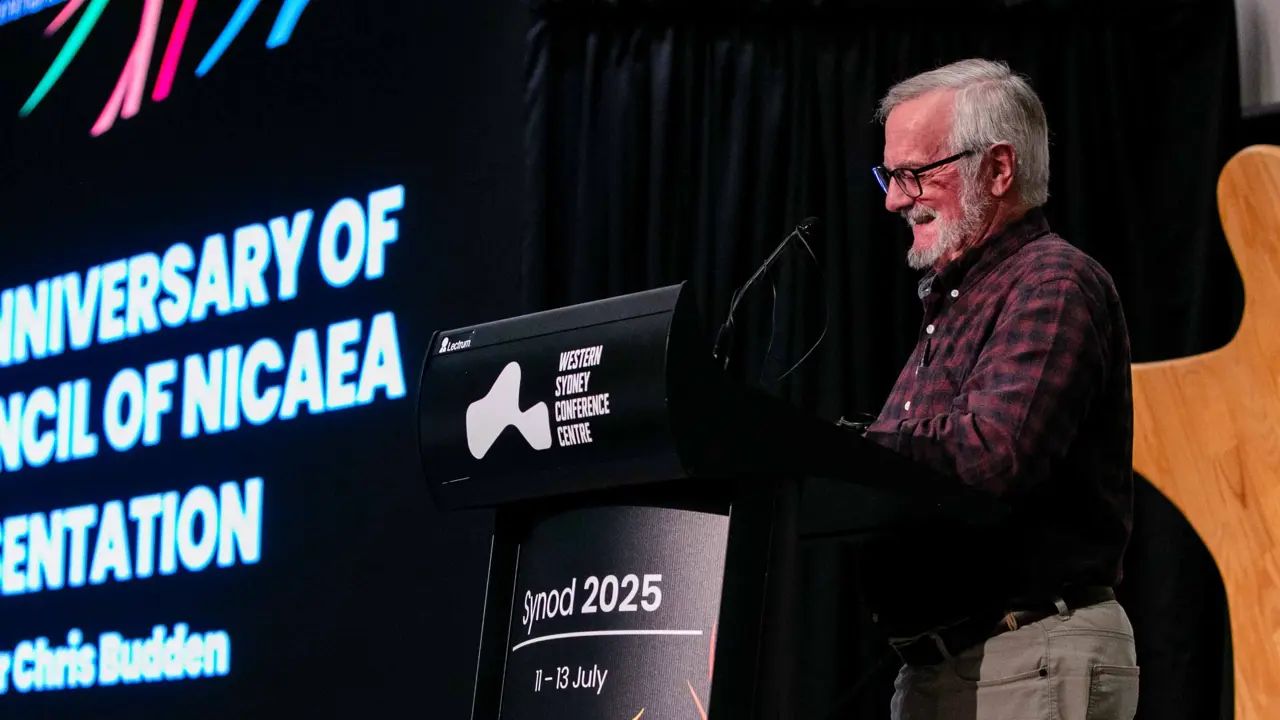
Wrestling with the Nicene Creed in 2025
At Synod 2025, Rev. Dr Chris Budden invited members to look again at the Nicene Creed — a core statement of faith shared by many Christians for nearly 1700 years.
At Synod 2025, Rev. Dr Chris Budden invited members to look again at the Nicene Creed — a core statement of faith shared by many Christians for nearly 1700 years. But instead of simply defending it, he asked hard questions about what it really says, what it leaves out, and what it has meant for the Church’s life in the world.
Chris started by asking why the Nicene Creed matters at all. He said it isn’t just about getting doctrine right. It shapes how we see God, the world, and each other. That “architecture of faith” then shapes how Christians live.
He gave some history. In 325CE, church bishops met at Nicaea, supported by Emperor Constantine, to settle an argument about Jesus. Was Jesus truly God, or something less? The Council sided with the view that Jesus really is God. But Chris noted this wasn’t just a debate about theology. It was also about power and about making faith reasonable in the eyes of the empire and educated society.
This led Chris to ask whose questions we answer today. Are we still shaping disciples, or mostly trying to show that faith makes sense in modern terms? And whose voices shape our faith — is it still mainly official church leaders and institutions, or do we listen to the ordinary, faithful people and their experience of God?
Chris talked about what happened when the Church became closer to imperial power. The bishops’ authority grew. The Church became more orderly and less open to messy, diverse voices. Over time, God came to be imagined less as the self-giving, suffering God seen in Jesus, and more as a distant, controlling sovereign. That view, he argued, helped support systems of domination: colonisation, slavery, and male control in church and family.
But Chris also reminded Synod that the Creed is not all bad. It gives Christians a shared language about God — especially about Jesus being truly God, and about the triune life of God as Father, Son and Spirit. At its best, it reminds us God is relational, not a lone ruler.
Still, there’s work to do. The Creed doesn’t mention Jesus’ teachings, his challenge to empire, or the call to radical discipleship. Chris said we should ask what else needs to be said today — in our place and time — so faith speaks more fully about God’s care, justice, and love.
He encouraged Synod to see receiving the Creed not as passive acceptance but as active work. This means asking:
– What kind of God do we reflect in our life together?
– Does our faith defend the powerful, or does it question them?
– How do we balance being part of an institution with leaving space for Spirit-led voices?
Chris also raised the importance of teaching about the Trinity and incarnation, not just as old doctrine, but as truths that shape how we live and what we value.
He ended by reflecting on a line he’d read: the bishops at Nicaea “met under the protection of the Empire.” That protection shaped what was said and what wasn’t. In Australia today, he asked, how might our faith also risk being shaped by the desire to fit in, to keep power, or to stay comfortable?
Chris’s hope was that the Nicene Creed can become again not just a statement to recite, but something that deepens worship, discipleship, and justice.
And he left Synod with these questions: What challenged or puzzled you? What would you add to the Creed, or say differently, so it speaks more clearly to life and faith in Australia today?
Chris’s hope was that the Nicene Creed can become again not just a statement to recite, but something that deepens worship, discipleship, and justice.