Women leading in the Uniting Church
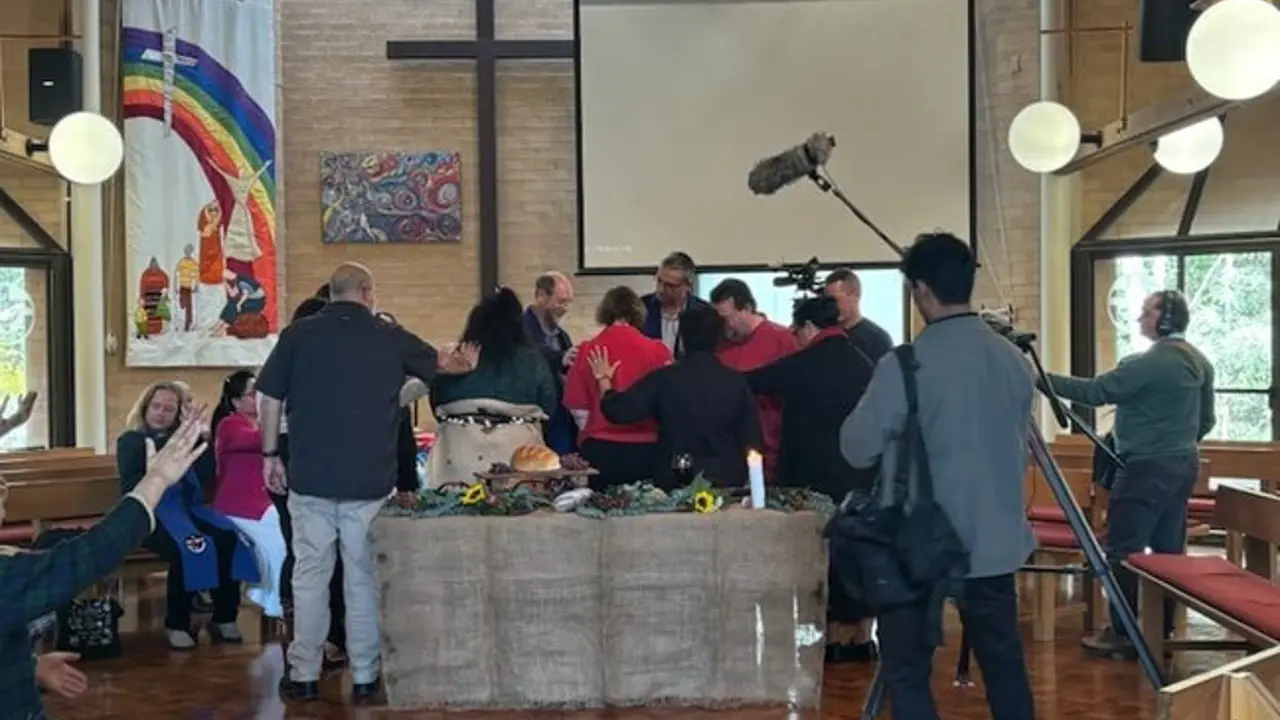
Recently the United Theological College (UTC) welcomed the ABC’s 7.30 film crew to capture a story on women in leadership roles across Christian denominations in Australia. In the brief segment, the Uniting Church’s approach to gender inclusion was positively highlighted, now we’d like to take the opportunity to explore the topic further with our Insights audience.
Recently the United Theological College (UTC) welcomed the ABC’s 7.30 film crew to capture a story on women in leadership roles across Christian denominations in Australia.
In the brief segment, the Uniting Church’s approach to gender inclusion was positively highlighted, now we’d like to take the opportunity to explore the topic further with our Insights audience.
Since its formation in 1977, the UCA has ordained women and placed gender and cultural inclusion as key elements of its identity.
“The ordination of women has never really been an issue for the Uniting Church,” UTC Dean of Candidates, Rev. Nicole Fleming said.
Since Union the Church has experienced a considerable increase in the number of women occupying leadership roles, whether that be as educators, ministers, executives or in governance roles.
Rev. Fleming said this has clearly been the case at UTC, where 15 of the 18 current candidates for ordained ministry are women, making up around 85 per cent of the cohort.
In his book celebrating the 25th anniversary of UTC, Rev. Dr. Geoff Barnes reported in 1979, only three women were listed as ready for ordination, with just one woman in first year. By 1983, women outnumbered men in first-year enrolments. By the mid-1990s, around 40 per cent of candidates were women, a figure that remained steady until a recent increase in the past two years.
Rev. Nicole Fleming sees the growing number of women at UTC as part of a broader movement.
“The diversity of the candidate body at UTC has changed significantly over the past 50 years. This speaks not only to broader changes in society but also to the Spirit moving in new ways,”
“Formation is not just about learning theology; it’s about learning to lead with humility, courage and a commitment to justice. We want candidates to be able to question systems that exclude and to build communities of care,”
“It’s clear in scripture, as well as in the history of the Uniting Church, God calls a range of people to leadership, including women. The current cohort of candidates reflects the diversity of our church, both socially and theologically. It is encouraging that so many women are feeling able to respond to the call of God to ordained ministry at this time,” Rev. Fleming said.
Principal of UTC, Rev. Dr. Peter Walker also commented on the gift of having so many women at the College.
“Each candidate is interviewed twice a year by their Formation Panel. And the people involved in those interviews are the panel members, who are experienced leaders of the church, the candidate, and I am there as UTC Principal. Not infrequently, I’m the only male in the room. And I often think, how wonderful is this! Where else is this happening across the church?”
The Moderator of NSW and ACT, Rev. Faaimata (Mata) Havea Hiliau - who is the sixth woman and first Tongan-Australian to lead the Synod - reflected on the importance of female leaders acting as role-models for others in the Church.
"When women lead in the Church, they don’t just shape ministries, they light the way for others to follow. Women like Lilian Wells, the first female Moderator of the NSW Synod, and Freda Whitlam, who served during the 1980s, these trailblazers set the stage of what was possible for other women,”
“When our leadership reflects the full breadth of God’s creation - across gender, culture, and experience - we embody a Church that truly listens, learns, and loves without limit. Diversity is not a challenge to unity; it is the Spirit’s gift to deepen it,”
Mata concedes that there are still ongoing challenges and barriers facing women and people from marginalised and multicultural communities.
“We still operate in a society where gender inequality and racism persists, and the Church is not immune to that. Unconscious bias continues to shape how leadership is perceived and who gets invited to the table. We have made progress, but there is still work to do. We must be alert to unconscious biases and not be afraid to lean into uncomfortable spaces and have uncomfortable conversations, because that’s where transformation happens,” Rev. Havea Hiliau said.
PLEASE NOTE: The ABC 7.30 segment incorrectly referred to two pastors being “ordained” when they were being “commissioned”.
“Formation is not just about learning theology; it’s about learning to lead with humility, courage and a commitment to justice. We want candidates to be able to question systems that exclude and to build communities of care,”