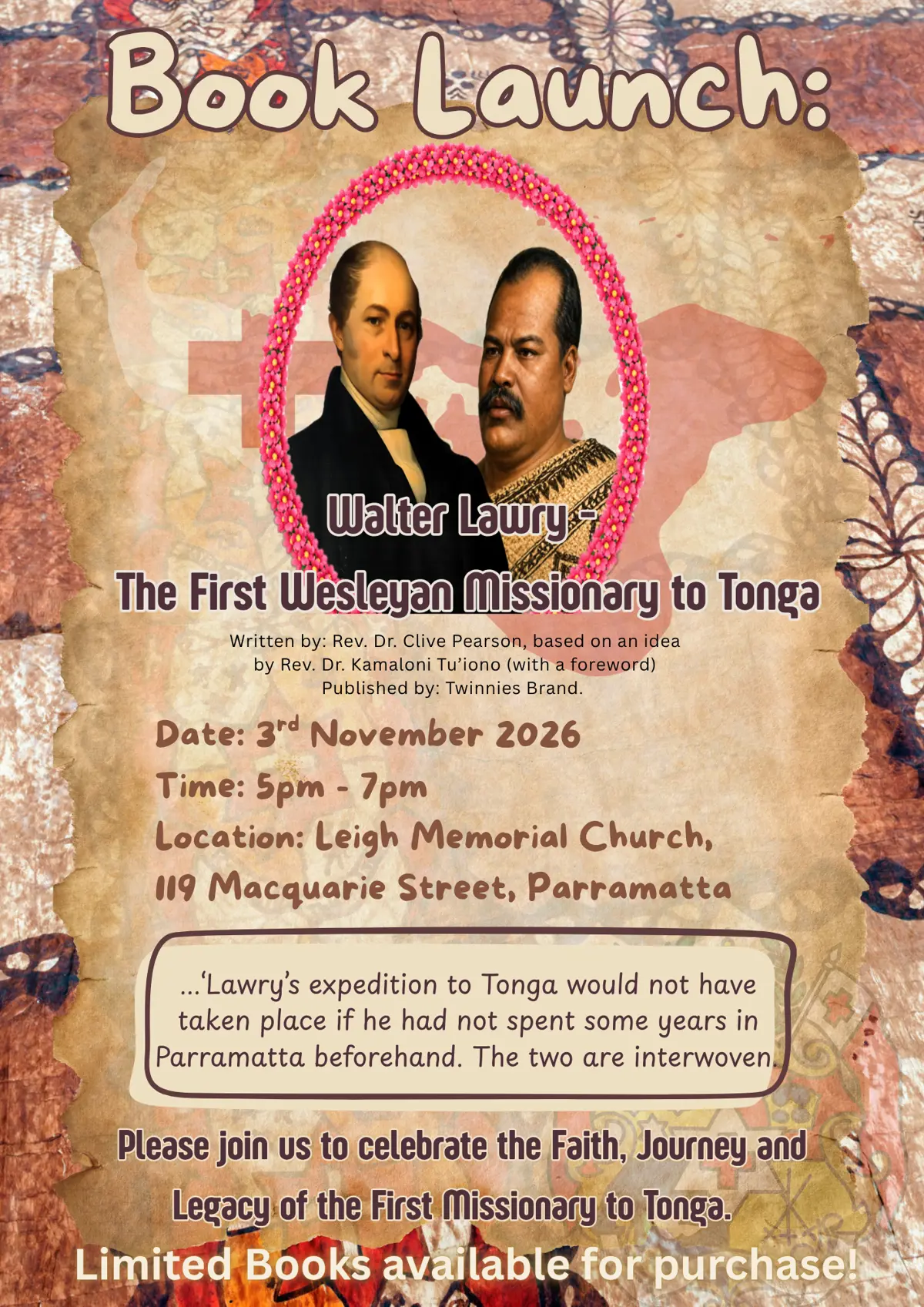
Walter Lawry: The First Wesleyan Missionary to Tonga
Clive Pearson, with a foreword by Kamaloni Tui’ono
Walter Lawry was the second Wesleyan missionary to Australia. In several of her works Liz de Reland gave an account of his being raised in Cornwall, his coming to Australia, the difficulty of his relationship with Samuel Leigh, his marriage to Mary Hassall and the role he played in the transition of the Wesleyan presence in the colony into a more settler institution. Lawry was instrumental in securing the site of the first chapel where Leigh Memorial is now in its third form; Lawry and Mary were responsible for the establishment of the first Wesleyan Sunday School. Liz made the distinction between Leigh being a ‘church Methodist’ (on account of his close relationship to Samuel Marsden and the Church of England) and Lawry a ‘chapel Methodist’.
This new book builds upon the work which Liz has done in several ways. There is more detail about Lawry’s Cornish background. Liz described Lawry’s going to Tonga and how he was on the receiving end of orders from London which had been informed by some mischievous reporting from Leigh. This new book establishes a closer connection between Lawry’s time in Parramatta and how he ended up, somewhat reluctantly, in Tonga. The period of time Lawry, Mary and their son, Henry, (less than a year old) spent in Tonga was a little over a year. The decision to leave after such a period has often been assigned to Mary’s health as she was expecting another child. That does not bear too much scrutiny. Lawry felt obliged to abandon his mission because of the need to defend his name and integrity over and against the false charges made by Leigh to those back in the mission offices in London. Marsden’s interventions had not helped. Lawry would make his way back to London via a layover in Parramatta. Lawry was able to put his case, despite opposition from an initially ill-informed ‘fathers’ of Methodism. Lawry’s mission to Tonga is so bound up with his ministry in Parramatta that it is impossible to understand in his time in the islands without the drama of his conflict with Leigh.
Lawry made two trips to Tonga – the first in 1822, the second in 1847 when he was asked to go and oversee the progress of the Methodist mission. It has been the practice of the Free Wesleyan Church to say that its origins date from 1826 with the work of John Thomas. The fact of the matter is that Lawry preceded Thomas; the lessons that he learnt from his time in Mu’a were laid out in a way which was designed to advise any future mission: he came to see himself as a ‘John the Baptist figure’. Lawry was an organizer. On the second voyage the missionaries presented Lawry with a dedication that acknowledged he was the first (despite lingering claims back in London that Thomas was first).
This books draws upon Lawry’s diary and Margaret Reeson’s Currency Lass with particular attention to the time Lawry spent in Tonga. The diary bears witness to Lawry’s struggles with ‘holiness’ and obedience in the Wesleyan tradition. It shows how he used his own funds to buy a share in the ship (the St. Michael, formerly a convict ship) to take him, Mary and Henry to Tonga. There had been prior discussion on whether Lawry should go alone: previous missionaries had been killed. It so happens that Mary was the first white woman to spend time on Tonga through her own decision; Henry was the first white child to be seen by Tongans on their own island. The Lawrys took various fruits and vegetables for planting; they were given a bull and cow by Governor Brisbane to take with them: these were the first cattle to ‘settle’ on Tonga where they were called ‘bull-ama-cow’.
Lawry struggled with the Tongan language - unlike Thomas. On arrival the language difficulties were overcome by the presence of a ‘Mr Singleton’ who had survived the shipwreck of his ship in 1806 and had been living among the Tongans ever since). Lawry had no support from any other missionaries. He was on his own in that regard and instructions from London were always out of date. It was difficult to explain the Christian faith to the local people (whom, on occasion, he called ‘Indians’). At times he was supported by the local chief, Palau; at other times the party were in fear of their lives. His diary abounds in what we would now recognize as racism. Lawry was not a trained anthropologist but his diary describes a number of cultural customs. When the Lawrys eventually left Mu’a (the ancient capital of Tonga) there was much weeping. When Thomas and other missionaries arrived in 1826, they were asked about where was Lawry and was he coming back.
The Lawrys landed in Tonga on the 16th August 1822; Walter was the first Wesleyan missionary to these islands. They took leave of the islands on 4 October 1823. There was a suggestion that Lawry might return in 1824, but it had become clear that his standing in the Methodist Church depended on his ability to defend himself in London to the ‘Committee’ and overcome the complaints against him which had started with Samuel Leigh.
Clive Pearson