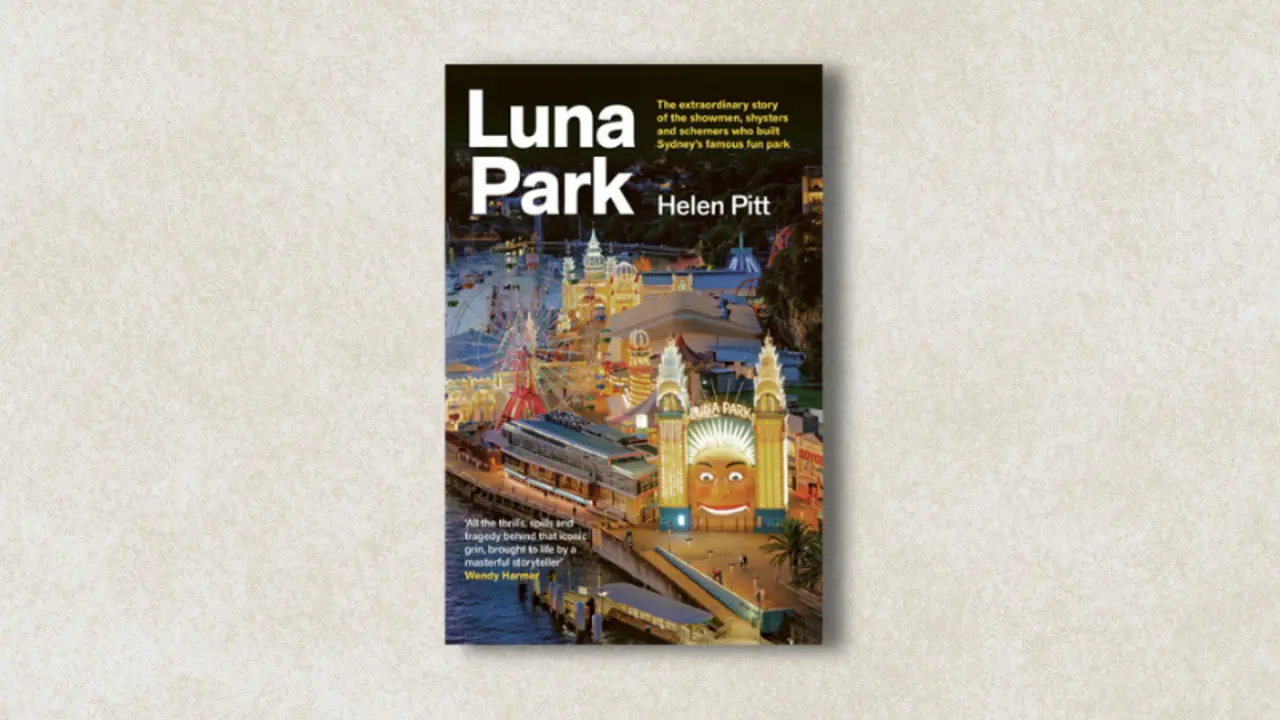
The Park That Refused to Close
From church warnings about corrupted youth to the 1979 Ghost Train fire, Helen Pitt traces the turbulent story of a park Sydney refused to lose.
Review: Luna Park, Helen Pitt, Allen & Unwin
The history of Sydney’s Luna Park inevitably lends itself to rollercoaster comparisons. In this book, Helen Pitt, also author of a book on the Sydney Opera House, describes the carnivalesque history of amusement park operations, the moral concerns and tragedy, and the ups and downs of simply keeping the park open, in the face of operating costs, greedy developers, NIMBY objections and the changing tastes of the public.
The park sits on a traditional Aboriginal women’s fishing spot. Pitt claims to detect some feminine energy in the area because of this; possibly the name has something to do with it too. Inspired by America’s Coney Island – Pitt goes into detail over the American origins of such amusement parks – the name was supposedly taken from the original American developer’s sister, though there was also, at Coney Island, a ‘ride to the moon’ using the name. The name was not copyrighted, so entrepreneurs were able to spread it around the world.
The history of Australia’s amusement parks is convoluted – entrepreneurs and innovations came and went. It doesn’t help that many of the hucksters and self-promoters were not always honest about their back-stories. Melbourne beat Sydney to the first amusement park; Luna Park Melbourne sits on the site of a former park. Sydney had the biggest, with Wonderland at Bondi.
A Luna Park operated in Adelaide’s Glenelg, but it fell victim to both Adelaide’s starchy culture, which frowned particularly on the idea of the park opening on Sundays, and the Great Depression. The equipment for Sydney’s Luna Park was shipped over from the failed Glenelg park. The famous mouth entrance was inspired by the Melbourne park but has been less manic and more friendly in its Sydney iteration.
Although it may seem slightly quaint these days, earlier in the twentieth century, politicians and church figures denounced amusement parks as attractive to criminal enterprises and corrupting of youth morals. There have always been the two sides of the park: attractive to children, but also a magnet for young adults, hoping to slip into the crowds and lose some of the moral restrictions of the day. A Sydney Presbyterian minister predicted ‘nightly orgies’. The history of Australian amusement parks suggests that divine retribution has been forthcoming: a park briefly flourished in Rushcutters Bay until it was badly damaged by lightning and dismantled. In Western Australia, two parks were shut down because of rogue snake bites and destruction from wild surf, as well as the almost-inevitable illegal activities.
Sydney’s Luna Park and the adjacent Olympic Pool were part of plans to bring people to the North Shore during the Depression, and its romantic waterside location is certainly a plus. Construction was a boon for workers previously employed on the Harbour Bridge. They assembled the painstakingly numbered Glenelg equipment at breakneck speed, and the park’s opening was wildly successful. Conservatives’ ‘worst fears’ were soon realised, due to the opening of the park and mixed bathing at the nearby pool, though there was some support from a local church. Park owners reciprocated, ensuring they supported local church events.
The park was not just an engineering feat: there was intricate artistic detail in the rides and facades. There was a silhouette artist on site. Later, significant Sydney artists worked on restorations of the original panoramas – Martin Sharp, Peter Kingston, Leigh Hobbes. Sharp said the park itself was one giant piece of art.
Of course, the park is a place of fun now forever linked to tragedy. Pitt not only ponders how terrifying the 1979 Ghost Train fire must have been for those who died (six children and one adult) but also shows how scarring it was for their family and friends. Martin Sharp became obsessed with the fire, creating a room in his house dedicated to research on it.
Initially, an electrical fault was blamed, but the evidence didn’t fit. Occult activity was mentioned, but a more recent conclusion is that it was arson, possibly carried out by bikies and ordered by a prominent Sydney crime boss with an eye on the lease of the park. NSW police were incompetent in their investigations, possibly corrupt. The issue is not settled, and there remain calls for further investigation, but Pitt is pessimistic that closure will ever be reached.
The fire could have meant death for the park. The history of the park during the eighties and nineties is, says Pitt, more complicated than when the park flourished, one of revolving lessees, closures, renovations, complaints over noise levels and plans for demolition. Public campaigns repeatedly saved it, but old fixtures were sold off, and the renovated park contains little that was original.
Competing entertainments in an online age might also have killed off the park, but now, ironically, its age has helped preserve it, through heritage listings and it being regarded as a state asset, as well as through the sheer nostalgia factor, something that explains the successful recent partnership with the Stranger Things franchise. And then there is something about its physical presence and old-world charm that screens can’t emulate and that gives it, these days, its point of difference.