Greta Gerwig’s Narnia and What Happens When You Try to Film Wonder?
There are some books you never quite leave behind.
They become part of the way you see the world, shaping what you believe is possible long after you have put them back on the shelf. When I think about The Chronicles of Narnia the stories have been with me since I could read. In fact I think I started reading them in grade four.
It appears to also be the case for Greta Gerwig. And now, with a reported $280 million budget and a vision designed for the biggest cinema screens, she has the opportunity to bring her version of that childhood wonder to life.
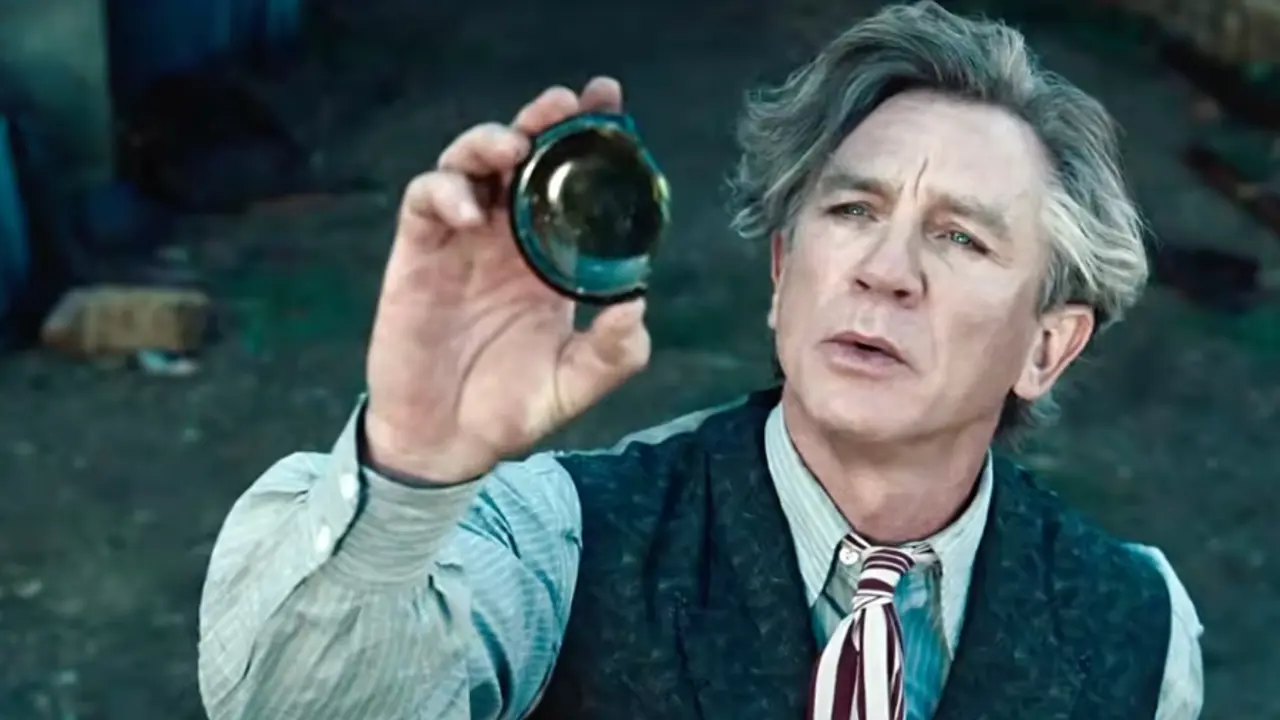
The first trailer for Narnia: The Magician’s Nephew has arrived, offering a glimpse of what Gerwig has been imagining. It is ambitious, strange and visually expansive, with Led Zeppelin’s Stairway to Heaven accompanying a journey into the origins of Narnia. There are magical rings, unfamiliar worlds, a familiar flying horse and, at the centre of it all, Aslan.
But what interests me most is not the scale of the production. It is the book Gerwig has chosen to adapt, and what it tells us about the kind of film she wants to make.
For many of us, Narnia begins with a wardrobe, a snowy forest and a faun carrying parcels. The Lion, the Witch and the Wardrobe has become the defining image of Lewis’s imagined world.
Gerwig is taking us somewhere else entirely.
Published in 1955, The Magician’s Nephew tells the story of Digory Kirke and Polly Plummer, two children who travel between worlds using enchanted rings. Their adventures eventually take them to a place where they witness the creation of Narnia itself. This is, in truth, perhaps the first multiverse story in fiction.
It is a remarkable premise. In a genre often preoccupied with battles, destruction and the struggle to save a world that already exists, Lewis gives us something different: the beginning of a world, brought into being through music.
Gerwig has described the book’s central image as a cosmic lion singing Narnia into life. She has said that the idea of a universe built out of music stayed with her from childhood.
In Netflix’s official announcement of the film, she recalls falling in love with that “gorgeously improbable but completely brilliant concept”.
I love that description because it captures something important about Lewis’s writing. His imagination was not limited by what seemed probable. He invited readers to entertain possibilities that reason alone might dismiss.
What would creation look like if we could witness it? What would it sound like? What would it mean to stand in a place where nothing existed a moment before, and then watch life begin?
These are not small questions. They are the kind of questions that can sustain an entire film.
Gerwig has made a career of looking closely at people. Lady Bird understood the complicated intimacy of family. Little Women found new ways to explore ambition, creativity and the restrictions placed on women. Barbie took a familiar cultural icon and used her world to ask questions about identity, freedom and what it means to be human.
Now she is working on a very different scale.
At the recent IMAX preview event in New York, Gerwig spoke about the opportunity to make a film in which creation, rather than destruction, takes centre stage. As she explained, films of this scale are usually about destruction. With The Magician’s Nephew, she gets to build a world.
This offers a clue to her approach.
The visual effects, the vast landscapes and the otherworldly imagery are not merely there to impress us. At their best, they should help us experience the magnitude of what Lewis imagined. If Narnia is being born before our eyes, the audience needs to feel the strangeness and possibility of that moment.
Gerwig has also insisted on making a film for the big screen. The movie will open in cinemas and IMAX on 12 February 2027, before arriving on Netflix on 2 April.
It is an interesting choice at a time when so much viewing happens on a television, laptop or phone. Some stories benefit from being watched in the middle of a room full of people, with the lights down and the image filling your field of vision.
A story about the birth of a world seems particularly suited to that experience.
Yet spectacle has its own risks. A film can be enormous without being moving. Digital landscapes can be beautiful without feeling real. And no amount of visual invention can replace the peculiar magic of a story that gives us room to imagine for ourselves.
The challenge for Gerwig is to make the spectacular serve the story, rather than overwhelm it.
There is another reason The Magician’s Nephew is such an intriguing choice.
Lewis was writing from a Christian imagination. His account of Narnia’s creation is not simply an origin story. Aslan’s song evokes the biblical account of creation, with life emerging through the power of a voice. The world is not accidental or meaningless. It is called into being.
That does not mean every scene needs to function as a theological lesson. Lewis was a storyteller, and Narnia works because its ideas are carried through characters, danger, humour, friendship and wonder.
But the spiritual dimension is there, woven into the fabric of the story.
Gerwig has spoken about her own faith-shaped upbringing and the influence of Lewis’s writing on her imagination. She has also described revisiting Lewis’s wider body of work and travelling to places associated with his life as part of her preparation for the film.
This suggests that she is approaching the material as more than a beloved intellectual property. She is trying to understand the person behind the books, the ideas that shaped him and the imaginative world he created.
That matters, particularly when adapting a story that carries religious meaning without behaving like a sermon.
The question is whether the film can preserve that sense of mystery. Can it invite an audience to feel awe without explaining away everything that makes the experience sacred? Can it give us something visually extraordinary while leaving space for questions about goodness, creation and our place in the world?
I hope it can.
There will inevitably be questions from devoted Narnia readers about Gerwig’s interpretation. The casting of Meryl Streep as the voice of Aslan has already prompted discussion, particularly given the character’s traditional portrayal as a male lion. My understanding of Aslan is that the character represents God, who is triune, and her choice seems incredibly apt for the non-gendered God who brings the universe into being.
The trailer’s musical choices and its expansive visual style also suggest a different sensibility from previous screen adaptations.
I understand the instinct to protect something that has mattered to us for years. These stories become entangled with childhood memories, family traditions and our own understanding of faith. A new interpretation can feel like an intrusion into a world we thought we knew.
But adaptation has always involved choices. A film cannot simply reproduce the experience of reading a book. It has to find its own language, using images, sound, performance and movement to express what words can do on a page.
Gerwig is not approaching Narnia as a custodian tasked with preserving every reader’s preferred version. She is a filmmaker trying to express what the story means to her.
There is something encouraging about a director who knows why a story matters to her and is willing to take its possibilities seriously.
Gerwig has said that Lewis’s books taught her to believe in magic, hidden worlds and adventure. They helped her imagine that ordinary people could be swept into something epic, and that wonder was available to everyone.
That is a lovely idea, and perhaps a more useful starting point than asking whether this Narnia will look exactly like the one we remember.
One of the things I appreciate about Lewis is his ability to make the familiar strange. A wardrobe becomes a doorway. A lamppost stands in a snowy forest where it has no business being. A lion sings a world into existence.
The magic is not only in the places his characters discover. It is in the possibility that the world we inhabit might contain more than we have noticed.
That is what I would like Gerwig’s film to recover.
We live in a culture that is very good at producing spectacle. We have increasingly sophisticated visual effects, enormous screens and the technology to create almost any image we can imagine. But wonder is not quite the same thing as amazement. Wonder asks us to pause, to pay attention, to recognise that there are things we cannot entirely explain or control.
A spectacular image might make us gasp. A genuinely wondrous story might change how we see the world when we leave the cinema.
The Magician’s Nephew offers Gerwig an opportunity to do both. Its central image, a world emerging through song, is extravagant enough to fill an IMAX screen. It is also intimate enough to remind us of the simple pleasure of encountering something for the first time.
Perhaps that is why this particular Narnia story feels so right for her.
She is returning to a book that helped form her imagination, with the means to realise its most ambitious ideas. The result will inevitably be her own interpretation of Lewis, shaped by her sensibilities and the choices she makes as a filmmaker.
I am curious to see what she does with it.
Not because bigger is necessarily better, or because a beloved story needs to be reinvented to remain relevant. But because a filmmaker who approaches a story with genuine affection, curiosity and a willingness to imagine might help us see it differently.
And sometimes that is what a good adaptation can offer. Not a replacement for the world we found in a book, but another doorway into it.