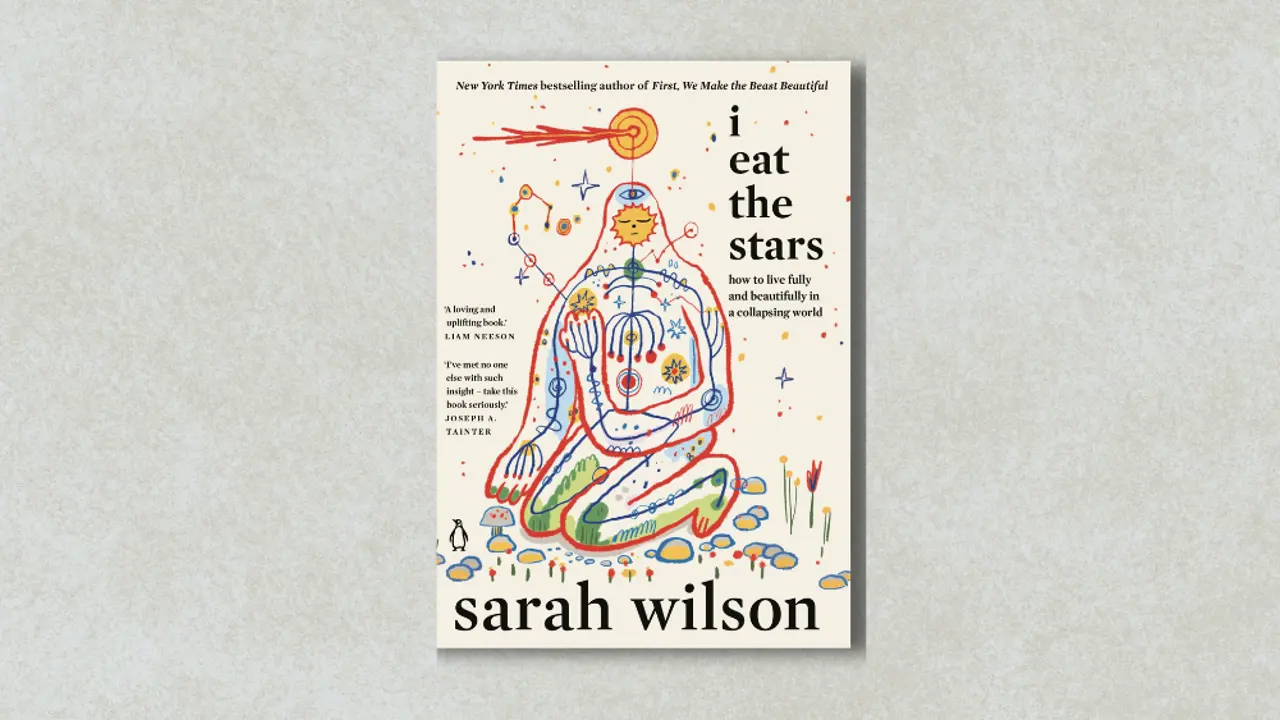
Ditching Hope for Realism
Sarah Wilson says it’s time to quit hope, face the collapse and get on with being an adult. The reviewer finds a kind of optimism in that anyway.
Review: I Eat the Stars: How to Live Fully and Beautifully in a Collapsing World, Sarah Wilson, Penguin
Sarah Wilson’s latest book is, she says, an exercise in quitting hope and facing up to the truth of the environmental crisis that confronts us and the inevitability of societal collapse.
There are multiple signs of collapse around us, not just environmental, but in corrupt elites hoarding wealth and the suppression of democracy (what Naomi Klein calls ‘end times fascism’), while populations are distracted by celebrity culture and mainstream media act as if it is just business as usual. Wilson adds that there has been a decline in social responsibility but an increase in emphasis on rights of the individual.
We have now breached seven of the Stockholm Resilience Centre’s nine planetary boundaries, indicating profound instability in Earth’s systems. Even energy companies are recognising that we may have passed the point of stable oil prices, as supplies shrink. The current, Trump-induced oil shocks may become permanent.
The French government is wargaming collapse scenarios (and the recent riots perhaps indicate the need to). China is clearly trying to put itself in a good position by moving steadily into the Pacific. Americans are becoming more insular, desperate to maintain their standards of living at the expense of others.
I suspect we might tackle some crises better than others, but Wilson writes that we have a ‘metacrisis’ because we can’t process all the ‘polycrises’. We can’t fix the system because we have lost trust in our ability to fix the system, partly because the system is set up to create endless growth while depleting the planet. Governments can only do so much because they are embedded in the system. Subsequently, Wilson has lost hope that we can turn things around.
All this, she says, may be too much to process for some, and there is, of course, a danger that the relentless pessimism about the climate will either numb us or paralyse us with fear. So, she suggests that some readers may want to skim earlier sections of her book to focus on the more positive aspects of ditching hope for realism.
The book was written on Substack, with input from readers, a move meant to foreground the importance of community, which gives it at times the feel of a book club discussion. It has its good and bad sides. There are the celebrity writer’s occasional indulgences that a more ruthless editor may have cut.
She calls up her friend Liam Neeson, and tells us what her friend Liam Neeson thinks about things. She writes about meeting the philosopher A C Grayling for regular drinks and thinks it’s important we know he is ‘drinking Chablis, me a Cotes du Rhone’. This, mind you, is in Paris, where she has gone to escape the climate crisis. (Oh that we could all do the same.) In search of romance in the city of romance, she writes that Parisian men are more philosophical than Australian men. (Take that, Aussie blokes!) Grieving, she runs through a forest listening to ‘a curated playlist of songs in a minor key’.
I was not sure about the author-reader interactivity of Substack transferred to the book, but other readers may applaud the collaboration, and I am not her audience exactly – she says her audience is middle-aged women. And it’s important to note that while becoming more fearless about expressing their opinions, these women are interested in community, often having raised kids and now interested in caregiving in a wider perspective.
She writes that a friend asked her, during the writing of the book, about some simple steps to take to prepare for coming crises. Somewhat wearily, Wilson says this is not possible – simple steps will not suffice. We need profound shifts in attitudes and practices, in order to rebuild after out current systems fail us.
Nevertheless, she does offer advice: be realistic about the present and the future, and be an adult, meaning caring for others, not putting yourself first and getting rid of the things that keep you an adolescent. By this she means making do with what is sufficient, rather than accumulating stuff, from either greed or a fascination with status. This is important because the wrong people are telling us about the ‘transition’ and arguing that we can simply keep our lifestyles by going electric. Of course, renewable energy sources are important, but the problem is consumption, as well as growing inequality, not just fossil fuels.
Ultimately, despite what she says, Wilson has a kind of twisted optimism, a form of hope. She writes that an inevitable collapse – whatever that might look like – forces us to change direction and head somewhere better. This may look more like traditional cultures – more spiritual, less materialistic, with an emphasis on reciprocity, careful use of resources, reverence for non-human life and ways of thinking that prioritise cycles and the longer term. As with the publicity around AI, she adds, collapse may help us focus on what aspects of being human we truly value.